There is a free video presentation on this topic that walks through the whole landscape, both case studies included. Link at the bottom of this article.
Most people think real estate investing starts with finding the right property.
It does not. The real decision happens long before you look at a listing, and most people do not realize they are making it: how much of your own time and energy do you want this to take?
That one answer points to a completely different set of strategies. Real estate is not a single thing you either do or do not do. It is a wide menu running from building a project out of the ground to wiring money into someone else’s deal and reading the quarterly update. All of it is real estate. All of it can work.
What follows is the short version of a training I recorded with Adam, a fellow investor with two decades in single family rentals, fix and flips and note investing. The goal of that session was not to tell anyone which path is correct. It was to lay out the landscape so you can find your own place on it.
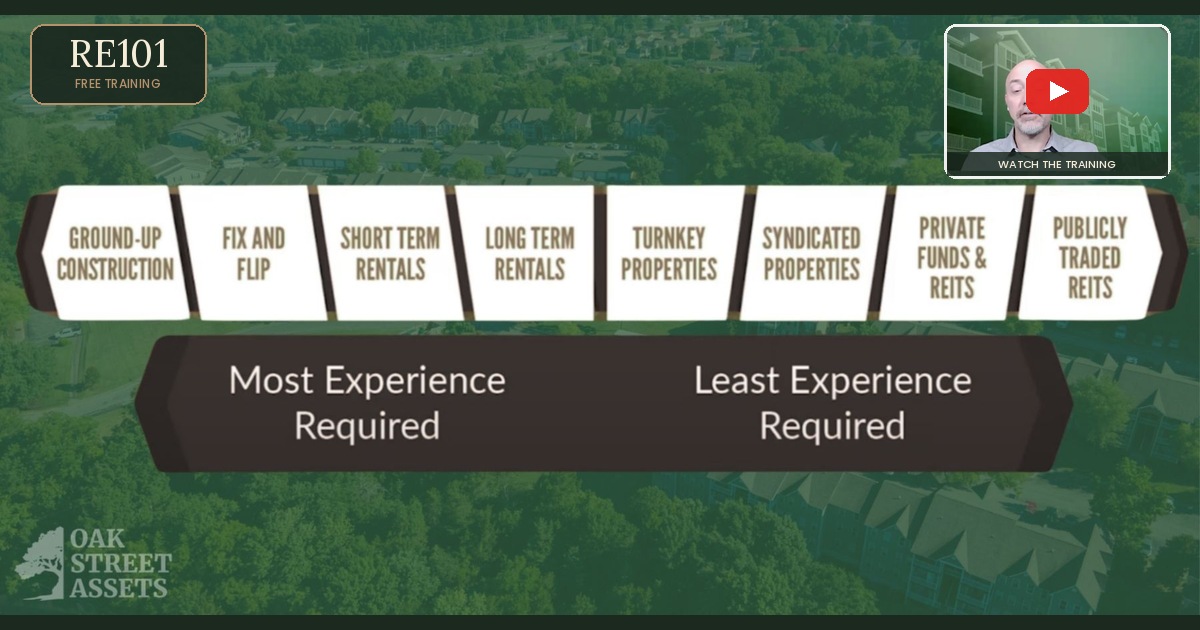
The landscape, end to end
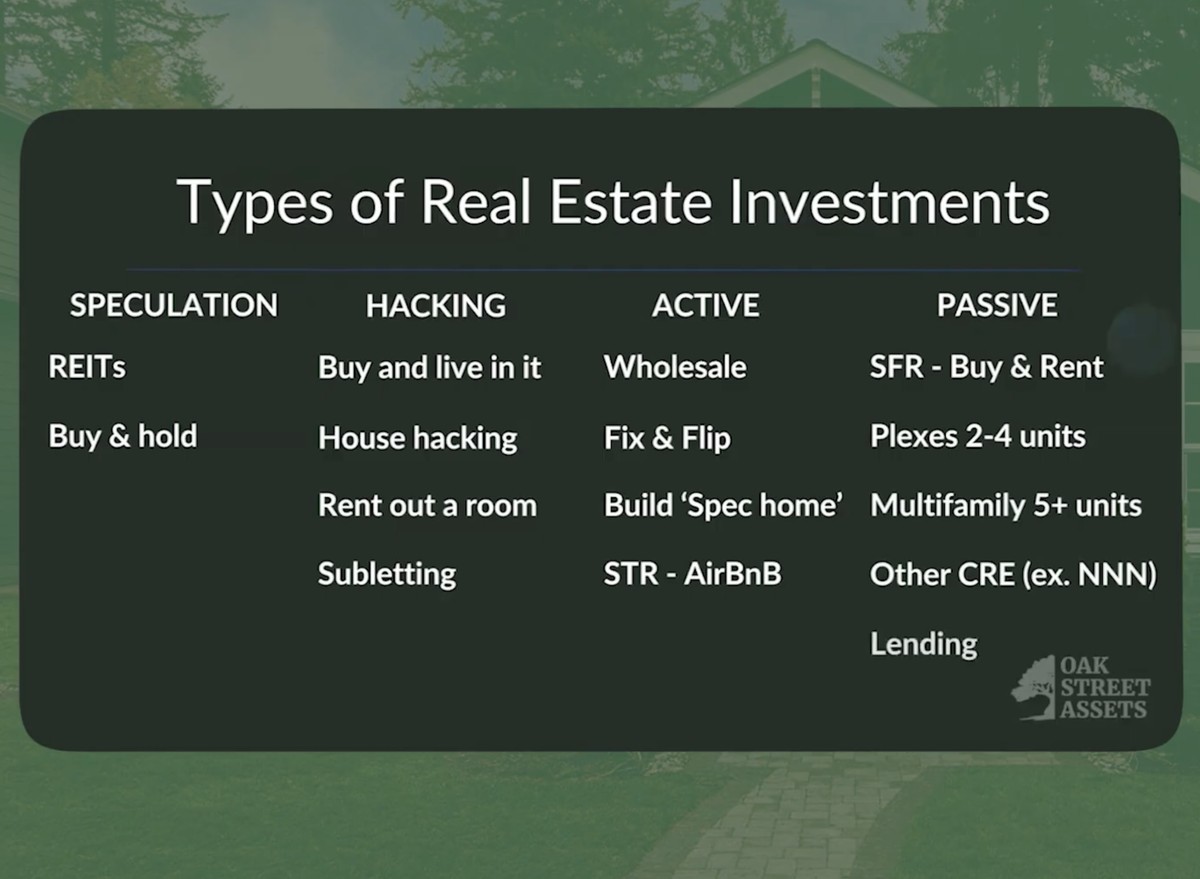
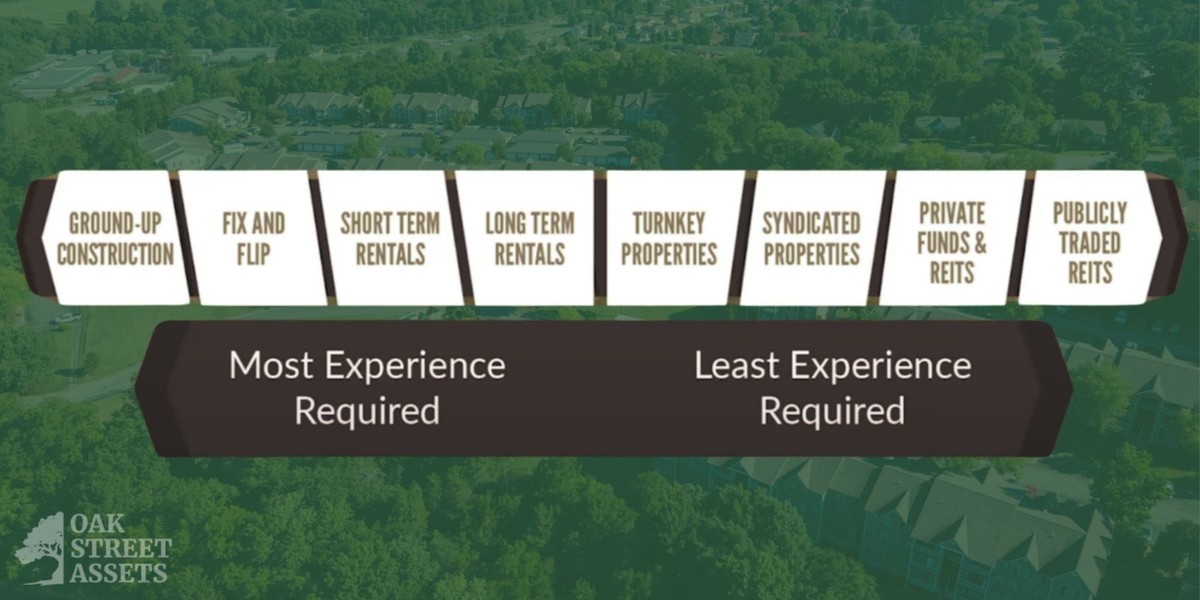
On the active end sit ground-up construction, wholesaling, fix and flip, and short-term rentals. These reward hustle and skill, can produce the fastest returns in real estate, and are generally taxed at the least favorable rates.
In the middle sit long-term rentals, small multifamily and turnkey properties. Real ownership, real control, and a real job attached. Even with a property manager you are managing the manager, choosing tenants and making capital decisions.
On the passive end sit syndications, private funds, lending and publicly traded REITs. Your capital does the work, an operator does everything else, and you trade control and liquidity for time.
Three inputs decide where you belong
Every deal on that spectrum runs on three things: time, money and knowledge. You can borrow any one of them. Partner with someone who has the capital. Hire the expertise. Pay for speed with a coach or a property manager. What you cannot do is show up short on all three and expect the property to cover for you.
Alongside those, a few questions sort people quickly:
- Growth, cash flow, or a hybrid?
- Equity side of a deal, or holding the debt?
- Home runs, or base hits you can plan a retirement around?
- How much liquidity do you need? Real estate is not liquid, and part of the return is compensation for that.
- Are you in the building phase or the keeping phase?
Neither end of the spectrum is better than the other. A mismatch between the strategy and the person is what causes the damage.
An example before the case studies
Here is the math most people never run before buying a first rental.
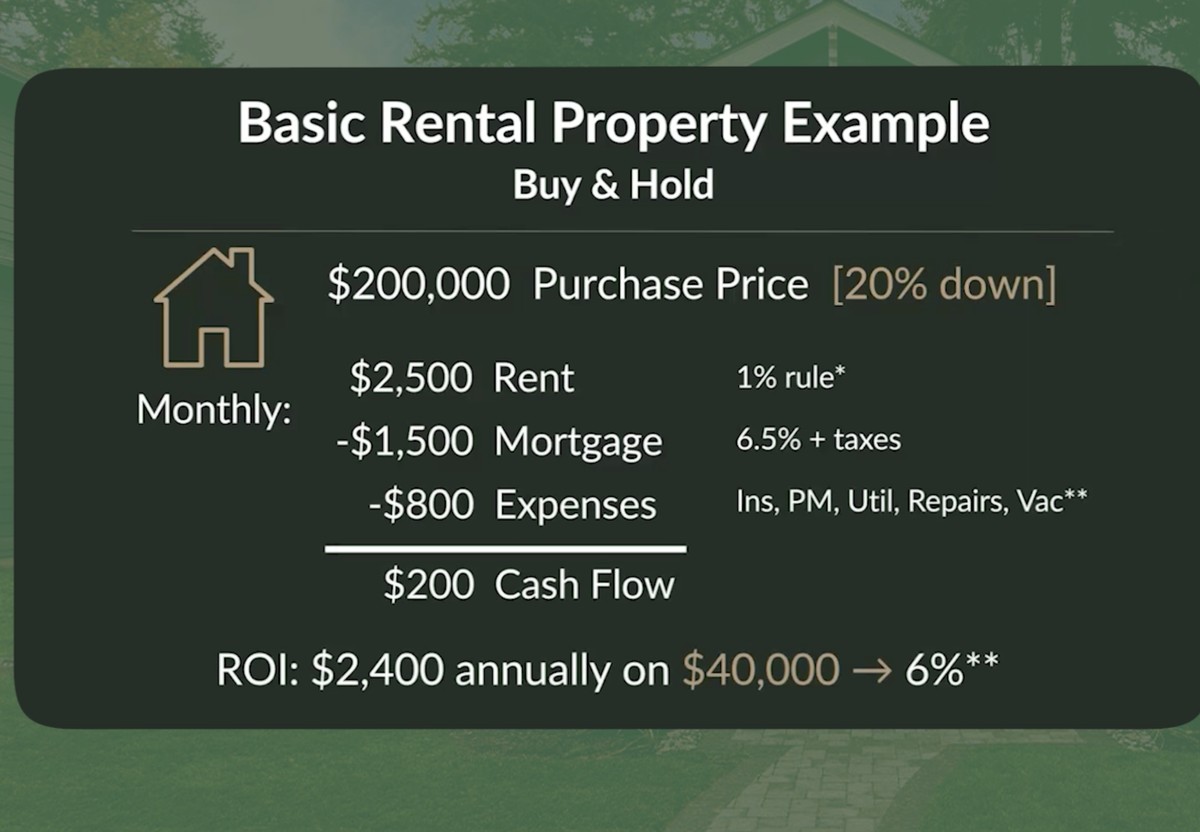
A $200,000 house with 20% down puts $40,000 of your capital to work. Rent of $2,500 against a $1,500 mortgage and $800 of expenses leaves $200 a month, which is $2,400 a year, about 6% on the cash in.
Two caveats matter more than the example. The 1% rule used here, monthly rent at roughly 1% of purchase price, is a napkin sketch rather than a buying criterion. In some markets it is conservative, in others it puts you underwater on day one. And a single vacant month wipes out most of a year of cash flow.
Cash flow is also only one of four ways the deal pays. Your tenant is paying down the mortgage, the property may appreciate, and depreciation shelters income along the way. Plenty of good investors buy properties that barely cash flow because amortization and appreciation do the work. Adam bought exactly that kind of property while working a full-time job, with rapid principal paydown and no meaningful cash flow, and many have since more than doubled in value while the debt did not.
Case study one, hands on: buying the debt
A $40,000 note on a Cincinnati home came through Adam’s network, offered by a holder who had tired of its non-performing status. He bought the note, not the house, for $16,000, which meant underwriting the borrower and the property from the outside and being ready to work through the outcome either way.
The borrower resumed paying $334 a month on a note written around 9% over 25 years. Measured against $16,000 rather than $40,000, that payment works out to roughly a 25% annual yield, and it was done inside a self-directed IRA. Had the borrower not resumed paying, the fallback was foreclosure on a $40,000 asset for about $20,000 all in, or a deed in lieu to skip the process.
Low effort once it is running, high knowledge to get there. That combination is the honest description of a lot of what gets called passive. Retirement accounts bring their own rules, covered in UDFI and IRA investing in real estate syndications.
Case study two, hands off: an apartment community
Commercial property is valued off income rather than comparable sales. Net operating income divided by the market cap rate sets the value, so raising income raises value on a multiple. Add $250,000 of annual NOI in a 5% cap market and you have added roughly $5 million of value whether or not the market moved. That is forced appreciation, and it is the reason we like value-add multifamily.
In 2017 we invested alongside an operator in a 168 unit Las Vegas community acquired at about $73,000 per unit. Rents moved roughly $275 a unit, which is about half a million dollars of additional annual income across the property, and it sold three years later at about $140,000 per unit. For investors that was a 2.5x equity multiple, roughly a 50% average annual return, and a $50,000 investment returned about $125,000.
The investor’s job in that deal was to review the offering, sign, fund, and then read updates and hand a K-1 to a CPA each year. That was a home run rather than a typical result, and the clearest illustration I have of forced appreciation working with leverage.
The mismatch is what hurts people
A friend of mine, an anesthesiologist, bought a 30 to 40 unit apartment building out of state and figured he could run it remotely. COVID hit, things went sideways, and he lost hundreds of thousands of dollars. The asset class was not the problem. He had the money but not the time, the bandwidth or the operating experience, on top of a demanding medical career. Selling at a loss cost him less than spending every free hour trying to save it.
Nobody is immune. Adam went at it like a bull in a china shop early on and paid for that education in real money. We walked away from a deal in West Texas in 2022 when the Fed started raising rates and our capital partners could not perform, which cost us hard earnest money, because the alternative was putting investor money into a deal whose math had changed.
The lesson is not “go passive.” It is to pick the lane that matches what you actually have to give.
If you go passive, vet in this order
Most people evaluate a deal backwards. They ask about the property, then the returns, then eventually who is running it.
Reverse it: sponsor and team first, then the market, then the property and the projected returns. A weak sponsor can ruin a good property, and a strong one rarely operates in a bad market to begin with. Bet on the jockey.
It helps to know what the general partner does for that scrutiny: sourcing and underwriting, letters of intent, due diligence, earnest money, legal and lender costs, signing as loan guarantor, then running the asset and the business plan through to sale. The work and the risk sit with the sponsor, which is exactly why the sponsor is the first thing you examine.
Both roads are good, pick yours on purpose
Some people genuinely love finding the deal, running the crew and turning a tired property into a good one. That work is worth real money, and doing it yourself is how you keep it. Skill is rewarded in this business, and ignorance is punished.
Others earn far more per hour in the career they already built. For them, Saturdays on a rehab is an expensive hobby, and their capital does better where someone else’s expertise does the lifting.
Return on investment is usually a financial calculation. Once you are earning well, your time is one of your best assets, and the honest version of ROI counts the hours you put in, not just the dollars.
It is worth remembering what all of this is for. A hundred years ago the Vanderbilts and the Rockefellers were two of the wealthiest families in America, both heavily invested in real estate. One built mansions, more than ten on Fifth Avenue alone, beautiful and expensive to hold. The other built income-producing commercial property. One fortune was largely gone by the 1970s. The other is bigger than ever. The Williams Group studied 3,200 families and found 70% of family wealth is gone by the second generation and 90% by the third, not because people stop earning, but because the systems were never built. More on that in why Oak Street Assets exists and the earned income trap.
If you want the whole landscape laid out, the full training walks through every strategy on the spectrum, what each one demands, both case studies in detail, how to evaluate a sponsor, and where to start given your own time, money and experience. It is free and runs about 45 minutes.
Watch Real Estate Investing 101
And if you want the detail on the passive options specifically, that is Can You Really Invest Passively in Real Estate?
Grow Beyond Wall Street.
#plantingacorns
Tim Fergestad is the principal of Oak Street Assets, a boutique alternative investment firm focused on passive real estate. For educational purposes only. Nothing here is investment, tax or legal advice, and nothing here is an offer to sell or a solicitation of an offer to buy any security. Past performance does not guarantee future results. The examples above describe specific outcomes, including one unusually strong one, and are not projections or expected returns.