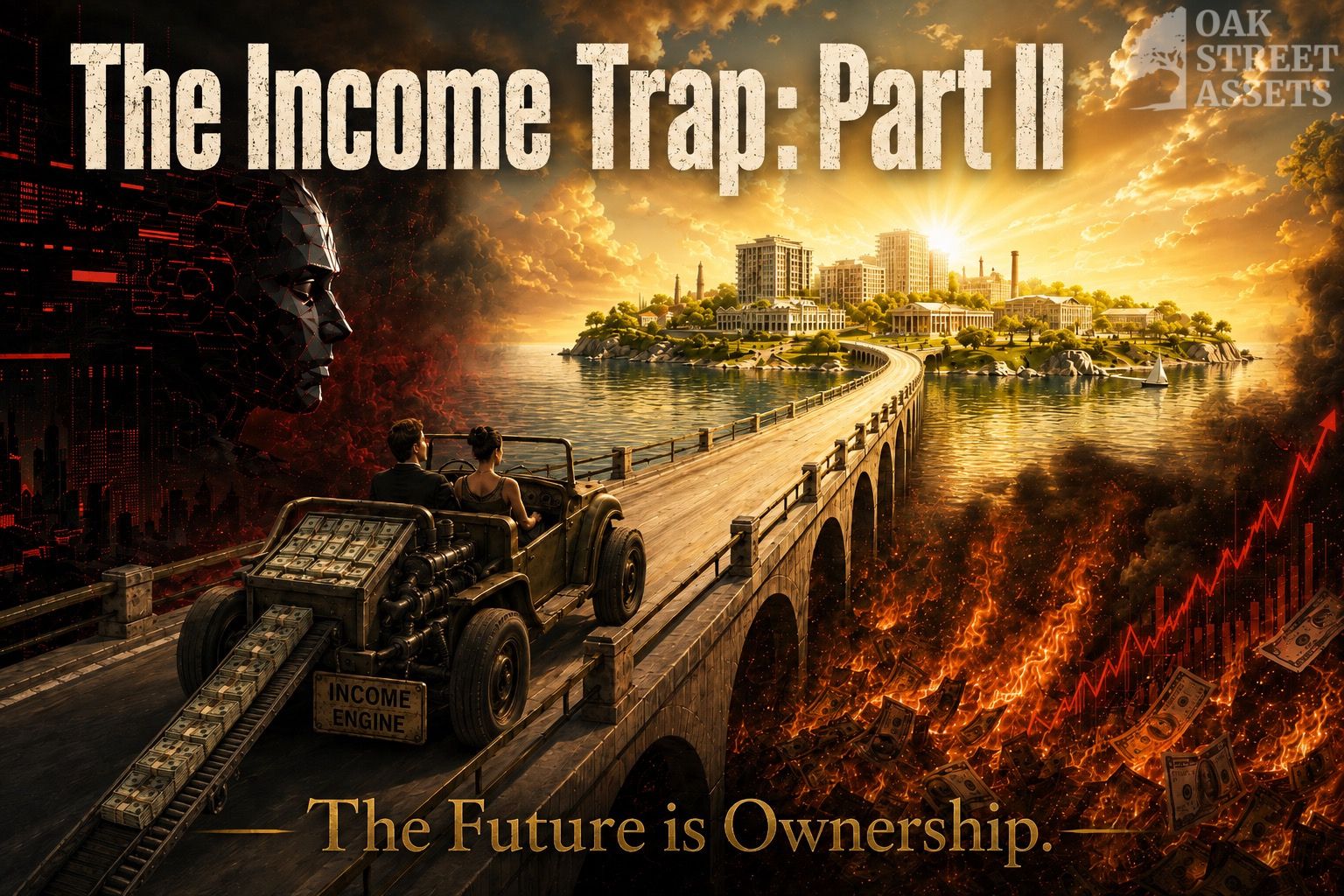
Why asset ownership may become more important than career success.
There are two forces quietly reshaping the American economy.
Artificial intelligence is coming for jobs. Inflation is coming for dollars.
One is compressing the value of labor. The other is compressing the value of savings. And most people are exposed to both at exactly the same time.
In Part I, we drew the line between the Income Economy and the Asset Economy. The people who trade time for money, and the people who own things that make money. This is Part II. And it answers a harder question:
When machines can do the thinking and dollars keep losing value, who actually wins?
The answer has not changed in a hundred years. It just matters more now than it has in my lifetime.
AI challenges the value of some labor. Inflation challenges the value of cash. Productive assets with durable demand can provide a defense against both.
A Quick Recap: The Two Economies
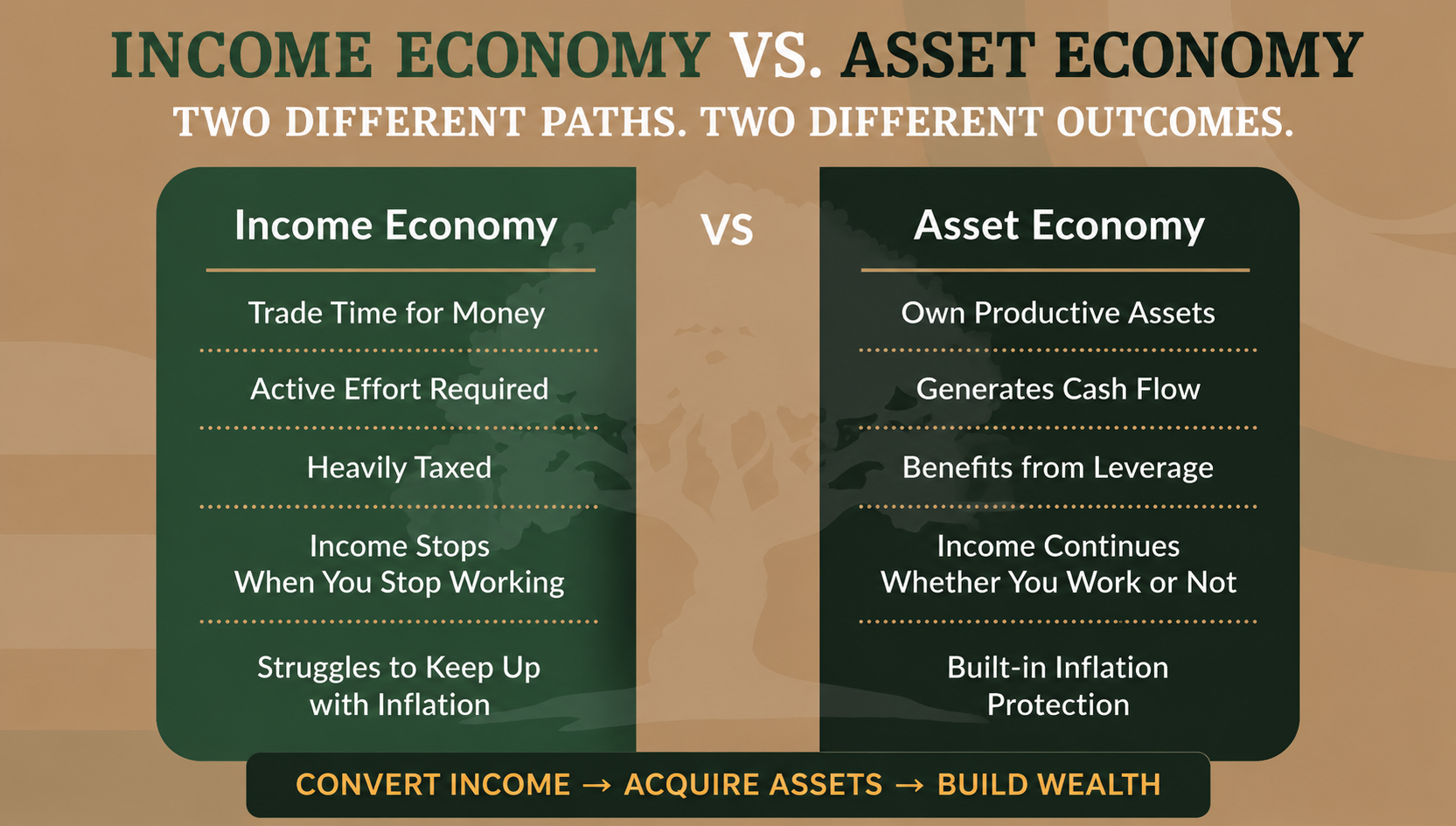
In the Income Economy, you are paid for what you do. In the Asset Economy, you are paid for what you own.
One depends on your continued effort. The other benefits from ownership, leverage, and compounding whether you show up or not.
For most of modern history, a high income felt like enough. Earn a good living, work hard for a few decades, and the rest would take care of itself. That assumption is now under pressure from two directions at once.
AI Is Coming for Jobs
For most of the last century, technology replaced physical labor. Machines did the lifting. Software did the calculating. The one thing that stayed safe was knowledge work. If you were educated, specialized, and highly skilled, your income felt protected.
Artificial intelligence is changing that assumption.
AI does not compete with muscle. It competes with knowledge. It reads, writes, analyzes, drafts, codes, diagnoses, and summarizes. The work that once required an expensive team of trained professionals is increasingly being done faster, cheaper, and around the clock.
This is the part few people want to say out loud: the jobs most exposed are not only entry level. Many are the well paid, white collar, knowledge based roles that people spent years and significant money training for.
I am not predicting mass unemployment. Skilled people will remain valuable. But the economics of labor are shifting. When a capability becomes easier to reproduce, some of its economic value shifts away from the person performing the task and toward the company, platform, or asset owner deploying the technology. If AI makes a certain kind of thinking cheap and plentiful, the wages tied to that thinking come under pressure.
When a skill becomes abundant, it becomes cheaper. Your income is only as durable as your skill is scarce.
Here is the uncomfortable follow up question. If a meaningful part of your financial security rests on selling your time and expertise, what happens when the market decides your time and expertise are worth less?
Inflation Is Coming for Dollars
Now layer in the second force.
Even if your income holds, the dollars you earn are quietly losing purchasing power. We covered this in Part I, and it is worth repeating because so few people truly account for it. At just 3% annual inflation, the purchasing power of a dollar is cut nearly in half over twenty five years.
Think about what that means. You can do everything right, save diligently in cash, avoid debt, live below your means, and still watch the real value of your savings erode year after year.
Cash quietly loses value. Productive assets quietly gain it. The gap between the two is where wealth is either built or lost.
The Debt Math Makes This Hard to Reverse
Here is why inflation is unlikely to simply go away.
The federal government now carries a debt measured in tens of trillions of dollars. Servicing that debt is one of the largest line items in the budget, and it grows as rates rise. A country in that position has only a few real options: raise taxes dramatically, cut spending dramatically, default, or allow steady inflation to quietly shrink the real value of what it owes.
History is fairly clear about which option governments tend to choose. Inflation is the politically quiet one. The debt stays the same on paper while the dollars used to repay it are worth less each year. It does not require a vote or a painful headline. It simply happens in the background.
This is not a partisan point. It does not matter which party holds power. The debt is the debt, and the math is the same for everyone. Neither side has shown a realistic willingness to raise taxes enough, or cut spending enough, to change the trajectory. When the underlying incentive points toward moderate, persistent currency devaluation, it is wise to plan as though that is the long term backdrop.
You do not have to like inflation to plan around it. The debt makes it the path of least resistance, no matter who is in charge.
Why This Time Reaches the Professional Class
For years, the standard advice was simple. Get educated, build a valuable skill, earn a high income, and you will be fine.
That advice built a lot of comfortable lifestyles. It did not always build wealth.
What makes this moment different is that both forces are now aimed at the same group. AI pressures the value of high skill labor. Inflation pressures the value of high income savings. The physician, the attorney, the engineer, the executive, and the business owner are no longer insulated simply because they earn well.
Earning well was always the starting point. It was never the finish line. The finish line is ownership.
Who Wins?
Step back and the pattern becomes clear.
AI may change who captures the economic value of work. Inflation changes who captures the economic value of money. In both cases, ownership matters.
That does not mean only the already wealthy win, or that your career is suddenly worthless. The best-positioned people in this environment fall into a few groups:
- Owners of businesses and productive assets.
- Professionals who use AI to increase their own output and income.
- Workers whose judgment, relationships, accountability, or physical presence remain scarce and hard to automate.
- People who convert those productivity gains and that income into ownership.
If you are a physician, an attorney, an engineer, or a business owner, your expertise may remain highly valuable for years to come. Many professionals will use these new tools to do more, serve more, and earn more. Your income is not the enemy. It is one of the most powerful engines you have.
The shift is subtler than “your job is doomed.” It is this: your income should fund your ownership strategy, not remain your entire financial strategy.
The best-positioned people will be those who use technology to increase their income, and then convert that income into ownership.
This is why the Asset Economy matters more now, not less. These two forces do not simply destroy labor and money. They move the economic value of both toward those who own productive assets, and reward those who turn a strong income into durable ownership.
The issue is not whether AI eliminates your job. It is whether you participate in the productivity it creates. The issue is not whether inflation raises prices. It is whether you own anything that can reprice with them.
Why Real Estate Sits in the Middle of This
Not every asset is built for this environment. A true asset produces income, provides utility, and benefits from real demand. Income producing real estate does all three. Properly selected and conservatively financed real estate can address both risks in ways that cash and earned income alone generally cannot.
It is hard for AI to replace
People will always need a place to live. Software can make a property run better, but it cannot remove the underlying human need for housing. Demand for well located, workforce housing is rooted in something AI does not change.
It is built to move with inflation
As prices rise, rents generally rise with them. Replacement costs climb. The value of the physical asset adjusts. Rather than being punished by inflation the way cash is, well operated real estate often participates in it.
It turns inflation into an advantage through leverage
Consider a property financed with long term, fixed rate debt. As the years pass, that debt is repaid with future dollars worth less than today’s dollars. Inflation works against the saver holding cash. It can quietly work in favor of the owner holding a productive, leveraged asset.
It comes with tax advantages that are hard to replicate
Depreciation, cost segregation, bonus depreciation, and 1031 exchanges mean that after tax returns can look very different from pre tax returns. For high earners feeling the squeeze from both sides, that difference matters.
None of this is a promise or a guarantee. Every investment carries risk, and real estate is no exception. The point is simpler. In a world defined by cheaper labor and cheaper dollars, owning the right productive assets is one of the clearest ways to stand on the winning side of both trends.
What To Do About It
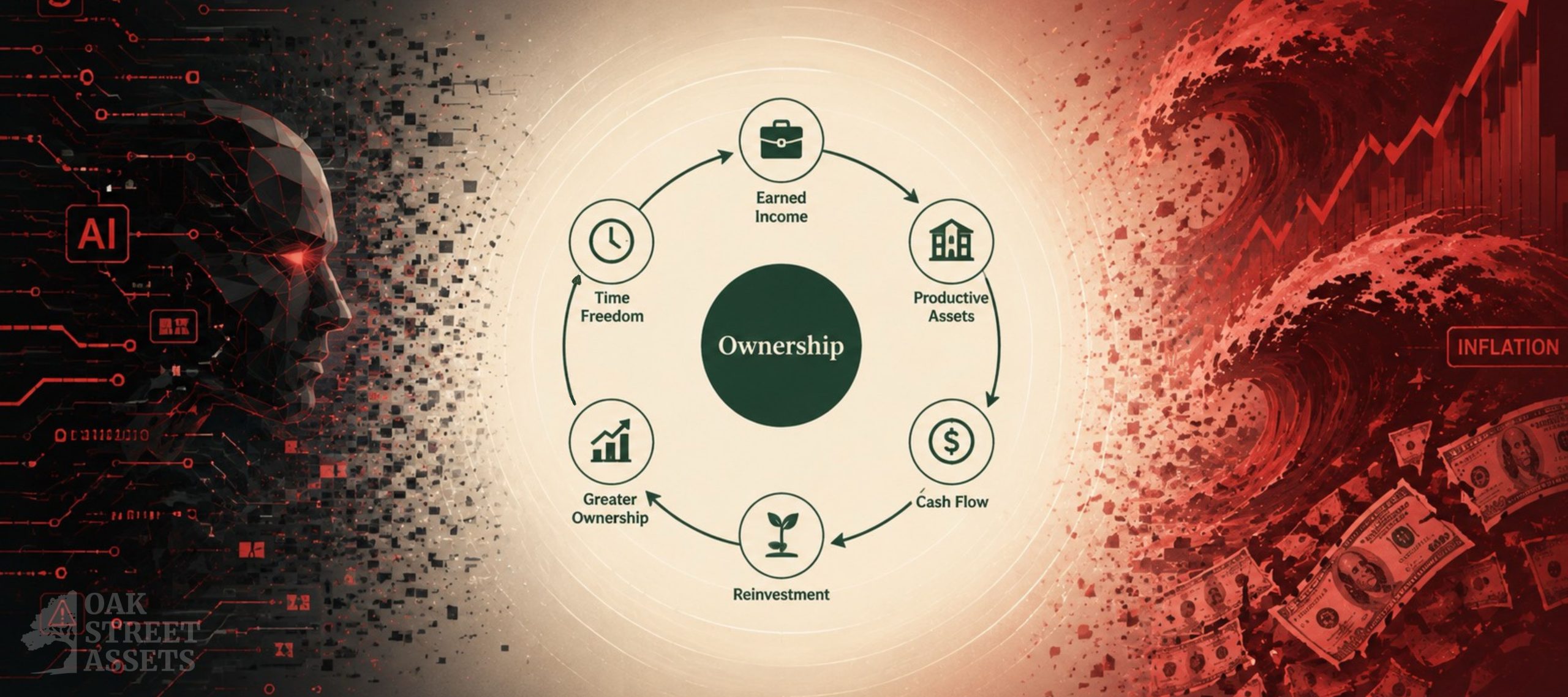
You do not need to predict exactly how far AI goes or precisely where inflation lands. You only need to position yourself so that you benefit rather than being left behind.
The move is the same one we described in Part I, and these two forces only make it more urgent:
- Convert earned income into productive assets, consistently and deliberately.
- Favor assets that produce cash flow and reprice with inflation.
- Use time and compounding rather than waiting for the perfect moment.
- Reduce your dependence on selling your time as your only source of security.
The goal is not to stop working. The goal is to reach the point where your assets carry more of the load, so that work becomes a choice rather than a requirement.
Final Thoughts
Every generation faces some version of this question. Ours simply arrives with new tools and the same old truth.
Technology will keep changing what our labor is worth. Policy will keep changing what our dollars are worth. The one thing that has consistently protected families across generations is not a bigger paycheck. It is ownership of productive assets that keep working long after the effort stops.
AI is coming for jobs. Inflation is coming for dollars. The people who turn a strong income into durable ownership are the ones who come out ahead. The only real question is whether you will be one of them.
Own Assets. Own Your Time.
Curious how Oak Street Assets helps high-income professionals convert earned income into durable, cash-flowing real estate assets?
Schedule a conversation here.