
I spent the first week of September on the Colorado River.
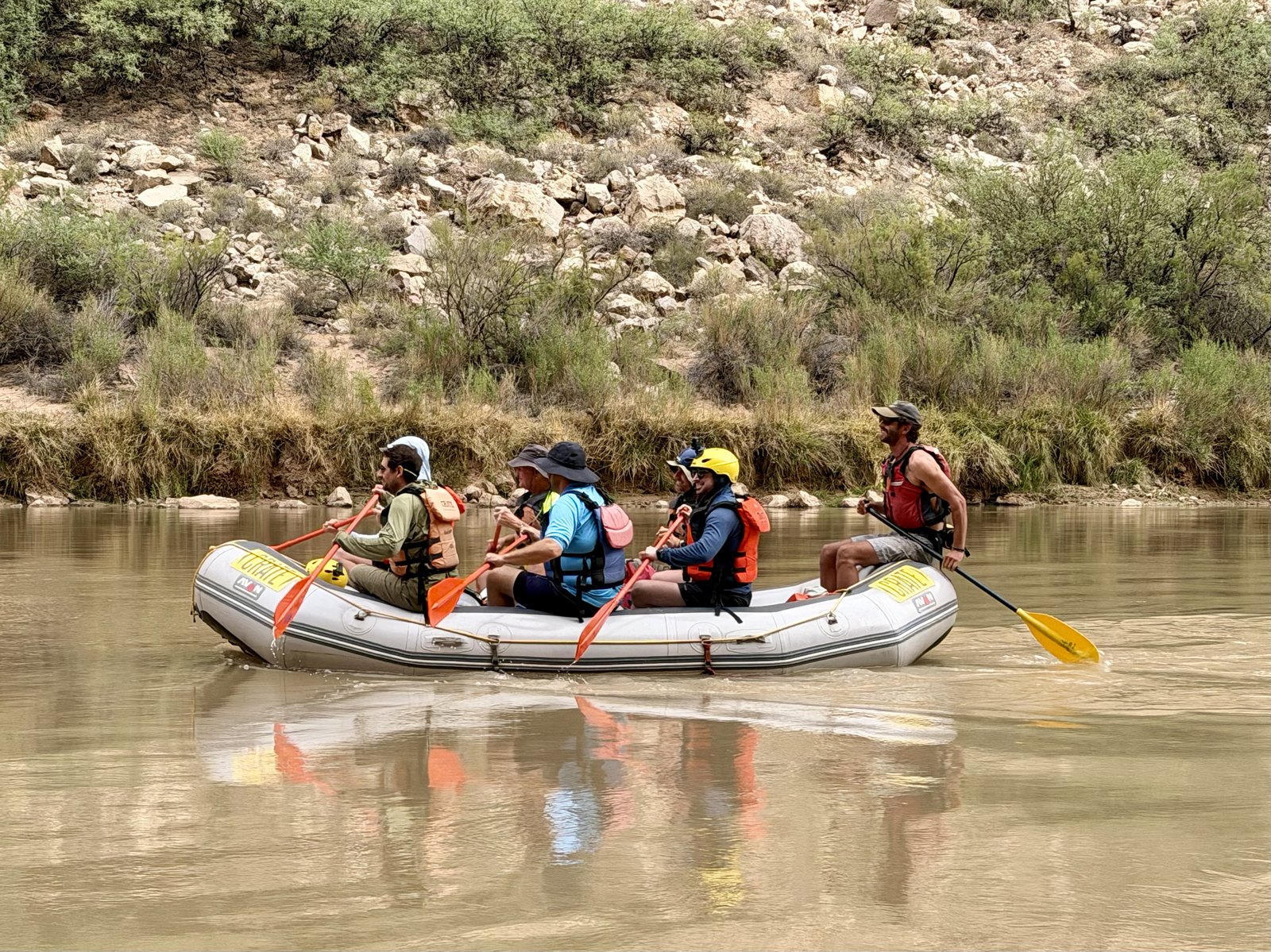
Five days in the upper Grand Canyon, rowing and paddling, hiking side canyons, then climbing out the South Rim at the end.
No phone. No email. The best kind of week.
But apparently the investor part of my brain does not completely turn off.
While everyone else was looking at the canyon walls, I kept looking at the water line.
Arizona continues to grow. TSMC’s planned investment in Arizona has now expanded to roughly $265 billion after another $100 billion commitment announced this summer. The plan now covers about ten semiconductor fabs, two advanced packaging facilities and a research and development center.
All those jobs require people.
People require housing.
And eventually somebody asks the obvious question:
Where is all the water coming from?
It is a fair question.
The answer is neither “Arizona has plenty of water, don’t worry about it” nor “Arizona is running out of water.”
The useful answer for a real estate investor is more local:
Arizona doesn’t have one water problem. It has many different water situations.
And that distinction matters.
First, yes, the Colorado River is under real stress
There is no reason to minimize what is happening on the Colorado.
The 2026 water year has been extremely dry across the basin. The Upper Basin had its worst snow drought on record, and when the runoff finally came down, streamflow came in at about 41 percent of average. Arizona remains in a Tier 1 Colorado River shortage, requiring a 512,000 acre-foot reduction in the state’s river supply. That is about 18% of Arizona’s normal Colorado River allocation, although it represents less than 8% of total statewide water use. Most of those reductions have fallen on lower-priority users, including agriculture and water-storage programs.
Here is the part that frustrates people who have been conserving. Arizona has been using less Colorado River water for years. At a talk I attended this month, Sarah Porter, director of the Kyl Center for Water Policy at ASU’s Morrison Institute, made the point bluntly: that does not solve it, because the river itself has been producing less for decades. Less snowpack, less runoff, less supply. You cannot conserve your way out of a shrinking source.
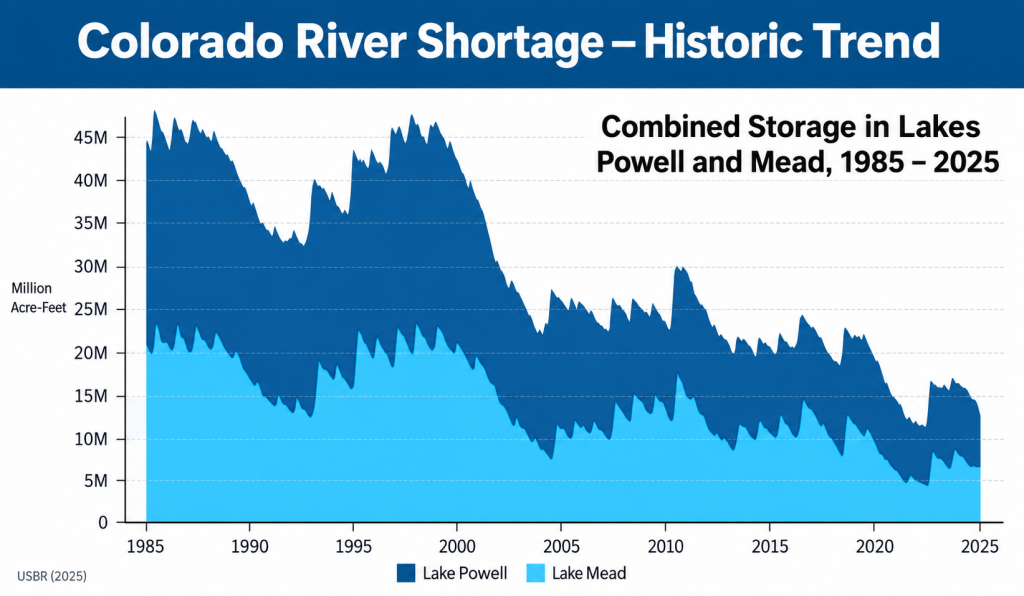
Lake Powell is also uncomfortably low.
As of mid-September, its elevation was about 3,517 feet, less than 30 feet above the 3,490-foot minimum power pool. Below that level, Glen Canyon Dam can no longer generate hydropower normally and its ability to move water downstream becomes more constrained.
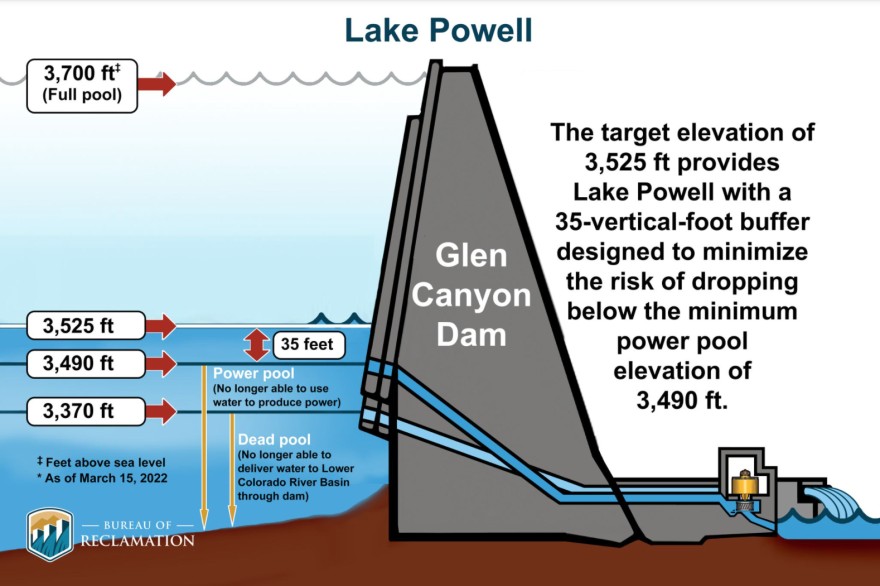
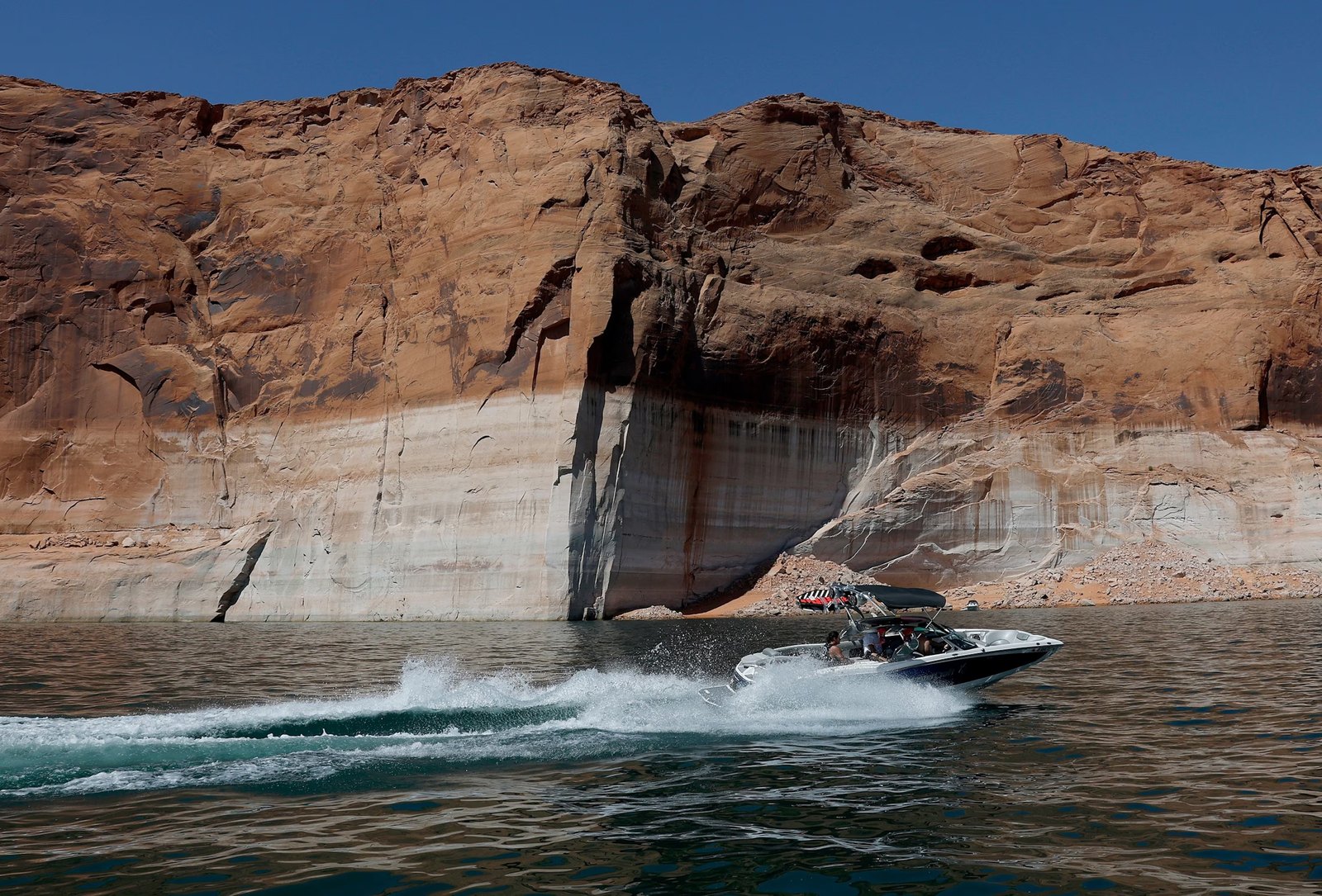
And the margin is thin. Reclamation’s own June projection, even after extra releases from Flaming Gorge upstream, has Powell slipping to about 3,488 feet by March 2027, below the minimum power pool. In plain terms, we are one bad winter away from Glen Canyon Dam no longer generating hydropower for millions of people across the West.
That would be expensive and disruptive. But Porter’s point was the one that stuck with me: electrons can be replaced and moved far more easily than water. The grid has other sources. Water is much harder to replace.
So the problem is real.
But that does not mean every Arizona city, development or property faces the same risk.
Arizona’s water system works on priority, not simply need
One of the least understood pieces of the story is that shortages are not shared equally.
Arizona receives 2.8 million acre-feet of the Lower Basin’s basic Colorado River allocation, while California receives 4.4 million and Nevada receives 300,000.
But when Congress authorized the Central Arizona Project in 1968, Arizona accepted junior priority for CAP water as part of the compromise necessary to get the project built.
That means CAP deliveries can be reduced before California’s basic 4.4 million acre-foot allocation.
So when someone says, “California is taking Arizona’s water,” that is not really what is happening.
California is standing in a priority position Arizona agreed to decades ago.
California isn’t taking Arizona’s water. It’s standing in a line we agreed to stand behind in 1968.
That matters because the Central Arizona Project supplies water to much of central and southern Arizona. It also explains why Colorado River shortages can sound enormous in the headlines while the impact on an established Phoenix household may be much less dramatic.
Who gets cut first matters.
A Colorado River shortage is really a groundwater problem
This was the framing from Porter’s talk that I found most useful, and it connects everything else in this piece.
Go back to the 1970s. A state water commission found that Arizona was pulling groundwater out of its aquifers at roughly 1.7 times the rate nature was putting it back. In the desert, only a tiny fraction of rainfall, around 2.5 percent by her figure, ever makes it down into the aquifer. We were mining a savings account that refills very slowly.
The Central Arizona Project was the rescue plan: bring renewable surface water from the Colorado so the state could stop draining its aquifers. The federal government attached a condition. No groundwater reform, no federal money for the canal. That pressure produced Arizona’s 1980 Groundwater Management Act, which created the Active Management Areas and the 100-year assured water supply rule I will get to below.
Much of that CAP water does not go straight to a tap. A lot of it is stored underground and pumped back out later for treatment and delivery. Parts of the West Valley work exactly this way.
So follow the chain. When CAP deliveries are cut, the users who lose that water do not stop needing it. Many of them go back to wells. A shortage on the river becomes pressure on the aquifer. That is why the Colorado River story and the groundwater story are really the same story, and why the fringe of the Valley is where it shows up first.
But the Colorado is not where most Phoenix water comes from
This is the part that gets lost almost every time.
When people read about Colorado River cuts, they picture Phoenix taps running dry. That is not how the system is built.
The Valley’s largest water supply is not the Colorado. It is the Salt and Verde rivers, delivered by Salt River Project.
SRP stores that water in seven reservoirs: four on the Salt, which are Roosevelt, Apache, Canyon and Saguaro, and two on the Verde, which are Horseshoe and Bartlett, plus storage on East Clear Creek. That system delivers to roughly 2.5 million people across metro Phoenix, more than half the population of Maricopa County. Those rights predate the Central Arizona Project by decades.
Here is why that matters to an investor: it is a completely different watershed.
The Salt and Verde are fed by Arizona snowpack and runoff from the forested high country to the north and east. A bad year on the Colorado is not automatically a bad year on the Salt and Verde. In recent years those reservoirs have filled and spilled while the Colorado kept declining. A Bureau of Reclamation study has also found the Salt and Verde supply is less likely to be affected by climate change than the Colorado system.
For the City of Phoenix specifically, the supply mix runs roughly 60% from the Salt and Verde through SRP, about 40% from the Colorado River through CAP, and only about 2% groundwater.
Two percent.
But not every established city looks like Phoenix. Scottsdale gets roughly two-thirds to 70 percent of its drinking water from the Colorado through CAP. The East Valley’s geology also does not hold groundwater as well as other parts of the Valley. That is a big part of why Scottsdale has been a leader in advanced water purification, treating recycled wastewater to drinking water standards. Two well-run cities, a few miles apart, with very different exposure to the same river.
Now here is where the theme of this whole piece shows up again.
Zoom out from the City of Phoenix to the greater Phoenix area and the picture changes considerably. Across the region as a whole, groundwater is roughly a third of total supply and it is the single largest category. The large established cities run almost entirely on surface water. Agriculture and some of the outlying providers lean much harder on groundwater.
So both of these are true at the same time:
- The major municipal providers are overwhelmingly surface water and barely touch groundwater. For the cities in the Arizona Municipal Water Users Association, surface water represented about 90% of drinking water supplies as of 2021.
- The region as a whole still depends on groundwater for a large share of its total use.
Which is exactly the point.
The answer depends on which Arizona you’re asking about.
A Colorado River headline and a Phoenix water bill are not the same story.
The Colorado matters. It is simply not the only thing holding up the Valley.
The other number that changes the conversation
Here is another fact that surprises people:
About 72% of Arizona’s available water supply is used by irrigated agriculture. Cities and industry represent a much smaller portion.
That creates an interesting dynamic as Arizona urbanizes.
Moving land from irrigated agriculture to housing does not automatically increase water consumption. In some cases, it can substantially reduce it.
Arizona has now formally built that idea into its water policy through the Ag-to-Urban program.
Eligible agricultural landowners in the Phoenix and Pinal Active Management Areas can permanently give up qualifying irrigation rights in exchange for groundwater savings credits that can help support new development.
The first approval is a good example.
The project generated enough water credit to support 825 new homes while the state estimates those homes will use more than 437 million fewer gallons of water each year than the property’s historic agricultural use, an approximately 80% reduction.
That does not mean every subdivision conserves water.
It does mean the equation is more complicated than “more homes equal more water use.”
Sometimes the prior use of the land matters as much as the future use.
Houses aren’t the problem. Houses on old farmland might be part of the fix.
The rule I care about most as a real estate investor
This is where the subject becomes much more practical.
Inside one of Arizona’s Active Management Areas, a new subdivision generally must demonstrate a 100-year assured water supply before the plat can be approved and lots can be sold.
There are two basic ways that happens.
1. The water provider already has a Designation
A city, town or private utility can receive a Designation of Assured Water Supply from the Arizona Department of Water Resources.
That means the provider has demonstrated that it can meet projected demand within its service area for 100 years.
If a development sits inside that service area and receives a written commitment of water service, the developer generally does not need to independently prove a 100-year supply for that subdivision.
2. The development needs its own Certificate
If the property is not being served by a designated provider, the developer may have to obtain a Certificate of Assured Water Supply for that specific subdivision.
That requires proving the water supply satisfies the state’s requirements, including physical and legal availability, water quality and financial capability.
There is also a cost tail that rarely gets mentioned. Homes in a certificated subdivision that rely on non-renewable groundwater generally carry a replenishment obligation, and that assessment shows up on the homeowner’s bill indefinitely. So this is not only a permitting question at the development stage. It eventually shows up in what a resident pays.
For me, that distinction is far more useful than asking whether “Arizona has enough water.”
Two pieces of land 20 minutes apart can have completely different water risk.
One may sit inside the service area of a major designated municipal provider.
The other may depend heavily on groundwater and still need to prove that supply.
They should not be underwritten the same way.
This is really a growth-at-the-fringe issue
In 2023, Arizona’s groundwater modeling projected that over a 100-year period, groundwater demand in the Phoenix Active Management Area could exceed physically available groundwater by approximately 4%.
That sounds alarming until you understand what the model was actually telling us.
The pressure is not evenly distributed across metropolitan Phoenix. The bigger issue is development that depends heavily on groundwater, particularly as growth pushes farther toward the edges of the metro.
What happened next is worth knowing, because the headlines were confusing. Arizona built that analysis into a rule, the rule was challenged, and this spring a Maricopa County judge struck it down. But the ruling was about procedure, not hydrology. The court found the agency had adopted a binding rule without going through formal rulemaking. It did not find that the Valley has more water than the state thought. Arizona has said it intends to appeal.
Which is worth stating plainly: the aquifer did not get any bigger this spring. What changed was who is allowed to build on the fringe, not how much water is underneath it.
This is why I would not interpret the groundwater debate as:
“Phoenix cannot grow.”
A more useful interpretation is:
“Some areas cannot assume groundwater alone will support unlimited growth.”
That is a very different statement.
Entitled land and available land are two different assets.
So how do I use this when looking at a deal?
For me, Arizona water risk comes down to a handful of practical questions.
Who is the water provider?
Is the property inside the service area of a provider with an Assured Water Supply Designation?
If it is development land, is there already a written commitment to serve the project?
If not, what is the path to proving the water supply?
How dependent is the area on groundwater?
What would happen to the economics if water infrastructure, replenishment or development requirements became more expensive?
Does the provider have a plan if the canal runs short?
Porter’s warning was that Arizona is one bad winter away from serious trouble on the Colorado, and that cities need to be ready for a year with little or no CAP water in the canal. Most of the major municipal providers have planned for this. Not all have. Everyone, cities and investors alike, needs a plan for that year.
Her view is that water rates need to rise regardless, to pay for that resilience. I agree. For an operating property, that is not a reason to walk away. It is an expense line to underwrite, and a provider raising rates to build redundancy is doing its job.
Those questions tell me much more than a statewide headline.
Underwrite the provider, not the state.
A Designated provider does not make water risk disappear. Water rates can increase. Infrastructure has to be maintained. Colorado River policy is changing. Groundwater remains a finite resource.
But the risk profile of an established property inside a major municipal service area is fundamentally different from a proposed subdivision on the edge of the Valley that still needs to establish its water supply.
That distinction matters to an investor.
And that brings me back to growth
TSMC did not commit hundreds of billions of dollars to North Phoenix without thinking about infrastructure.
Neither did the other semiconductor companies, suppliers and manufacturers following that investment.
Water is part of that infrastructure.
TSMC didn’t put $265 billion into a place that doesn’t have water. They asked harder than you or I would, and they asked before they poured a single foundation.
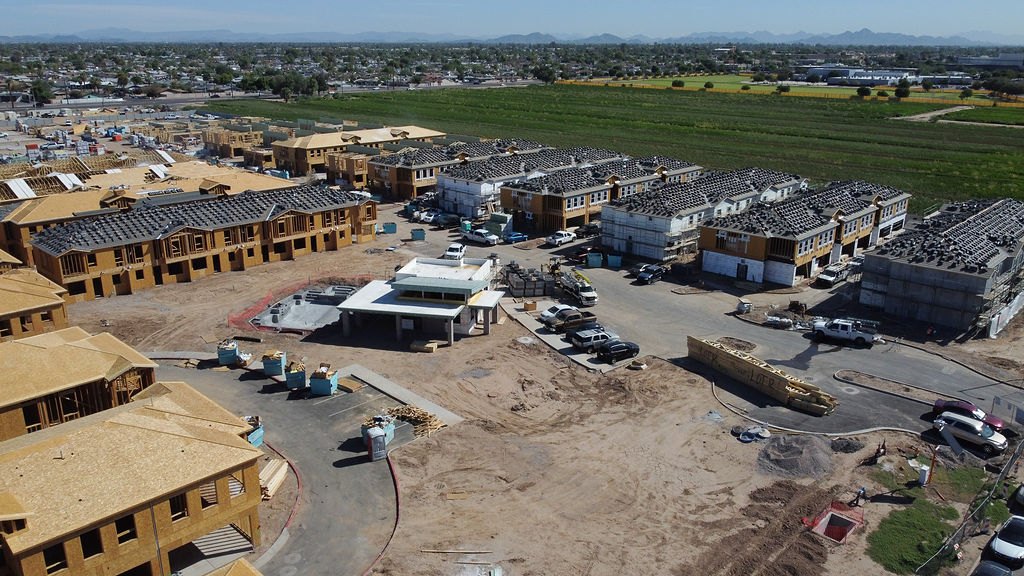
That is also part of why we pay attention to established municipal service areas when evaluating Arizona real estate, particularly around the North Phoenix growth corridor.
The thesis is not that Arizona has unlimited water.
It doesn’t.
The thesis is that water constraints are going to influence where growth can occur.
And that makes water availability part of real estate selection.
Growth doesn’t go where the land is cheapest. It goes where the water is provable.
Quality jobs need housing.
Housing needs reliable infrastructure.
And as Arizona continues to grow, the communities that can demonstrate reliable water supplies are in a very different position from those that cannot.
So when someone asks me:
“Does Arizona have enough water?”
I think that is the wrong question.
The better question is:
“Does this property, in this location, with this provider, have a reliable path to water?”
That is a question we can actually underwrite.
If you are thinking through how Arizona fits into your portfolio, or you want to talk through the questions we ask when evaluating a real estate investment, let’s connect.
And if you want the framework we use to evaluate a syndication before committing capital, our First Pass Scorecard and full Due Diligence Guide are available free at oakstreetassets.com/scorecard.
Grow Beyond Wall Street.
#plantingacorns
Tim Fergestad is the principal of Oak Street Assets, a boutique alternative investment firm focused on passive real estate. Nothing here is investment, legal or tax advice. Arizona water law is a specialized area, and deal-specific questions should be reviewed with qualified water and legal professionals.