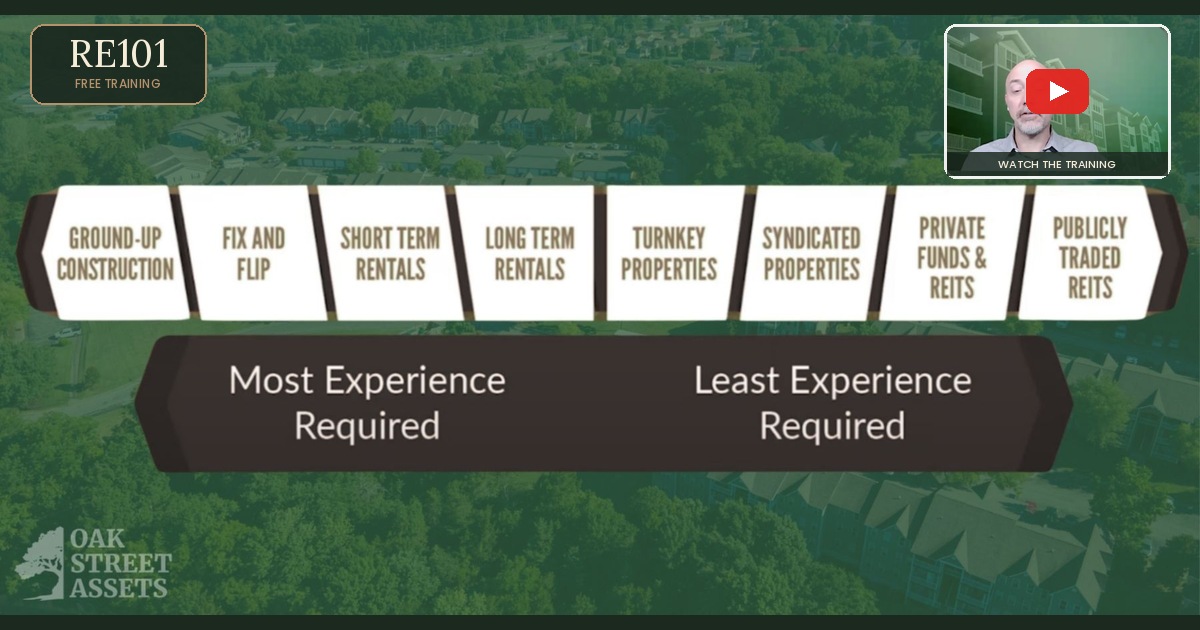

If you have ever wanted to invest in real estate but had no interest in being a landlord, there is good news: you do not have to be. Real Estate Investment Trusts, better known as REITs, let you invest in real estate without managing a single property yourself.
But not all REITs are the same. Some trade on the stock market (public REITs), and others are offered privately (private REITs). Understanding the difference is key to deciding which, if either, fits your goals. Here is how each works, the pros and cons, and where private REITs fit.
I will be candid about my own view up front: I am not a fan of public REITs, mainly because they tend to move with the stock market rather than with the underlying real estate. At Oak Street Assets we focus on owning real estate directly with our partners, and we also offer a private REIT, the Impact Lending Fund, which I will use later as one example of how private structures can differ.
What Is a REIT?
A REIT is a company that owns, operates, or lends against income-producing real estate: apartments, warehouses, retail centers, medical buildings, data centers, and more. Think of it as a way to pool money with other investors to gain exposure to real estate without buying property yourself. By law, a REIT must pay out at least 90% of its taxable income to shareholders as dividends, so investors receive regular income.
There are two main flavors:
- Equity REITs own and operate properties, earning income primarily from rent.
- Mortgage or debt REITs lend money against real estate and earn income from interest.
You may have heard the line that “REITs are real estate flavored stocks.” That is a useful oversimplification, and it applies most to the public variety. (For how REITs compare to owning real estate directly, see this companion article.)
Public REITs
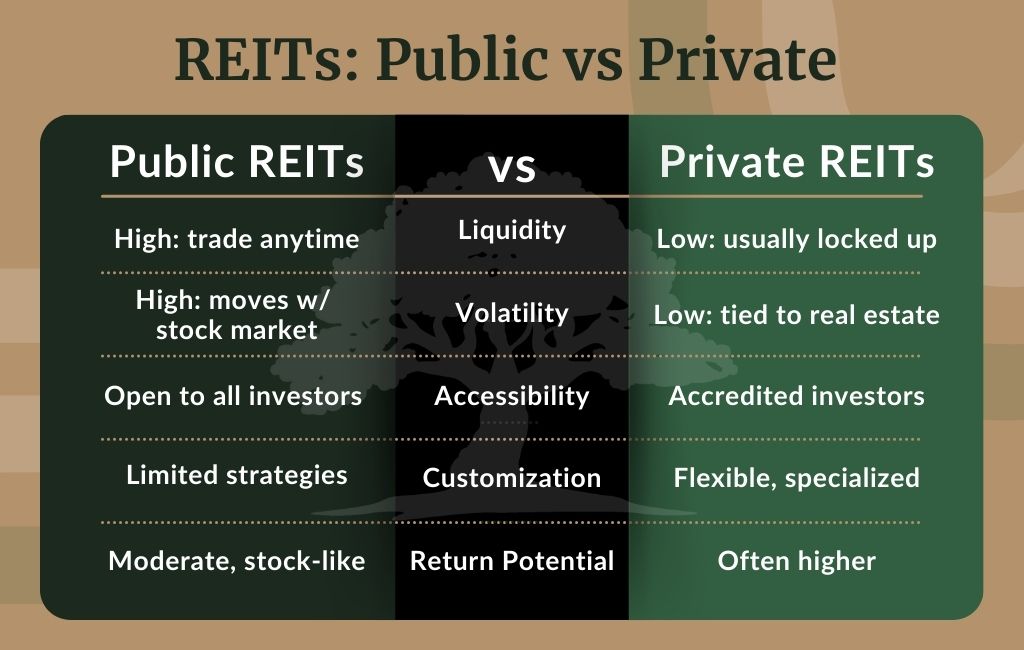
What they are: public REITs are listed on major stock exchanges. Anyone with a brokerage account can buy shares, which makes them one of the easiest ways into real estate.
Why investors like them:
- Easy to buy and sell, just like a stock, any time the market is open.
- Transparent, with frequent SEC-regulated disclosures.
- Accessible to everyone, with no accreditation required.
What to watch out for:
- They can fall with the broader stock market even when the underlying properties are performing fine.
- They often behave more like equities than like real estate.
- The costs of being a public company, plus management fees, can weigh on results.
Private REITs
What they are: private REITs do not trade on stock exchanges. They are usually offered through private placements and often require investors to meet certain income or net worth thresholds. Because they are not tied to the public markets, they can pursue specialized strategies.
Why investors like them:
- They are not repriced by the daily ups and downs of the stock market.
- Many target a specific niche, such as build-to-rent housing, healthcare facilities, or real estate lending.
- Structures can be tailored to prioritize steady income, growth, or tax advantages.
What to watch out for:
- Liquidity. Most private REITs have lock-up periods, sometimes five to ten years, so your money is committed for a while.
- Less frequent public reporting than an exchange-listed company.
- Access is usually limited to accredited or institutional investors.
Where the Impact Lending Fund Fits
For many investors the appeal of private REITs is straightforward: less exposure to stock market swings and the ability to participate in a focused strategy. The most common drawback is liquidity, because you typically have to commit your capital for years.
There is a reason investors are often willing to accept that trade-off. Committing capital for a period of time is frequently rewarded with what is known as the illiquidity premium.

Our Impact Lending Fund is one example of a private REIT structured to address that drawback. It is a private, debt-focused REIT with these defining features:
- Debt-backed structure. It lends against real estate, so its income is tied to interest payments rather than to swings in property values.
- No lock-up period. Unlike most private REITs, it is designed as an evergreen fund without a multi-year lock-up, so your capital is not committed for years at a time.
- Not correlated to the stock market. Because it is private and debt-focused, its value is not set by the daily equity markets.
- Purpose-driven. It supports real estate projects intended to deliver both financial and community impact.
I am sharing it as an illustration of how private structures can differ, not as a recommendation or an offer. Any actual investment is made only through the fund’s offering documents, which contain the full terms, fees, and risk factors.
The Bottom Line
REITs are a quick, accessible way to get exposure to real estate without becoming a landlord. Public REITs are the easiest to buy and sell, but they tend to behave like stocks. Private REITs can offer a focused strategy and insulation from daily market moves, usually in exchange for tying up your capital. And a smaller number of private structures, like our own fund, are built to soften the liquidity trade-off.
The right answer depends on your goals, your timeline, and your need for liquidity. If you want to think it through with someone who invests in this space every day, let’s talk.
You can also read more about the Impact Lending Fund, or explore two related reads: REITs vs. owning real estate directly and can you really invest passively in real estate?
Tim Fergestad, PhD, is the founder of Oak Street Assets, a boutique alternative investment firm in Scottsdale, Arizona. This article is for educational purposes only and is not investment, tax, or legal advice, and is not an offer to sell or a solicitation of an offer to buy any security. Any investment in the Impact Lending Fund is made solely through its offering documents, which include important risk factors and disclosures. All investments involve risk, including possible loss of principal. Consult your own advisors before investing.
#plantingacorns