
Every year, as tax season ramps up, I get a wave of messages from investors asking some version of the same question: “I got this K-1 — what do I do with it?”
Some people are worried it’s a tax bill. Some are confused about why it shows a loss when they know they made money. Some are frustrated it arrived in April instead of January.
All of that is completely normal. And all of it makes sense once you understand what a K-1 actually is — and what it isn’t.
Let’s walk through it. Simply. Quickly. No surprises.
First — Don’t Panic. Extensions Are Normal.
- Most real estate investors file extensions every year
- K-1s are often finalized after April
- Filing early = higher chance of errors or amended returns
- Extensions allow for accurate reporting and full depreciation benefits
Filing an extension is common, typically without cost, and reduces audit risk.
“File complete. File right. File once.”
Filing an extension for your personal return is straightforward and, done correctly, actually reduces audit risk by ensuring accuracy. Your CPA handles this routinely.
What a K-1 Actually Is
A Schedule K-1 is simply your share of the partnership’s tax activity for the year. It’s generated by the entity you invested in — the LLC or LP that holds the property — and sent to you so you can include those figures on your personal return.
Think of it like a W-2, but for your share of a business. It reports what happened at the investment level and passes your portion of that activity through to you.
What it reports:
- Income or loss — your share of the investment’s taxable activity
- Depreciation — the non-cash deduction that is one of real estate’s greatest tax advantages
- Credits — any applicable tax credits flowing through from the entity
What it is not:
- Not a tax bill
- Not your full return
- Not a statement of your cash distributions
It is one input among many that your CPA uses to prepare your return. That’s it.
What to Actually Look At (Only 3 Things Matter)
K-1s can look intimidating — there are boxes everywhere. The good news: most of them won’t apply to you. As a passive real estate investor, here’s where to focus your attention.
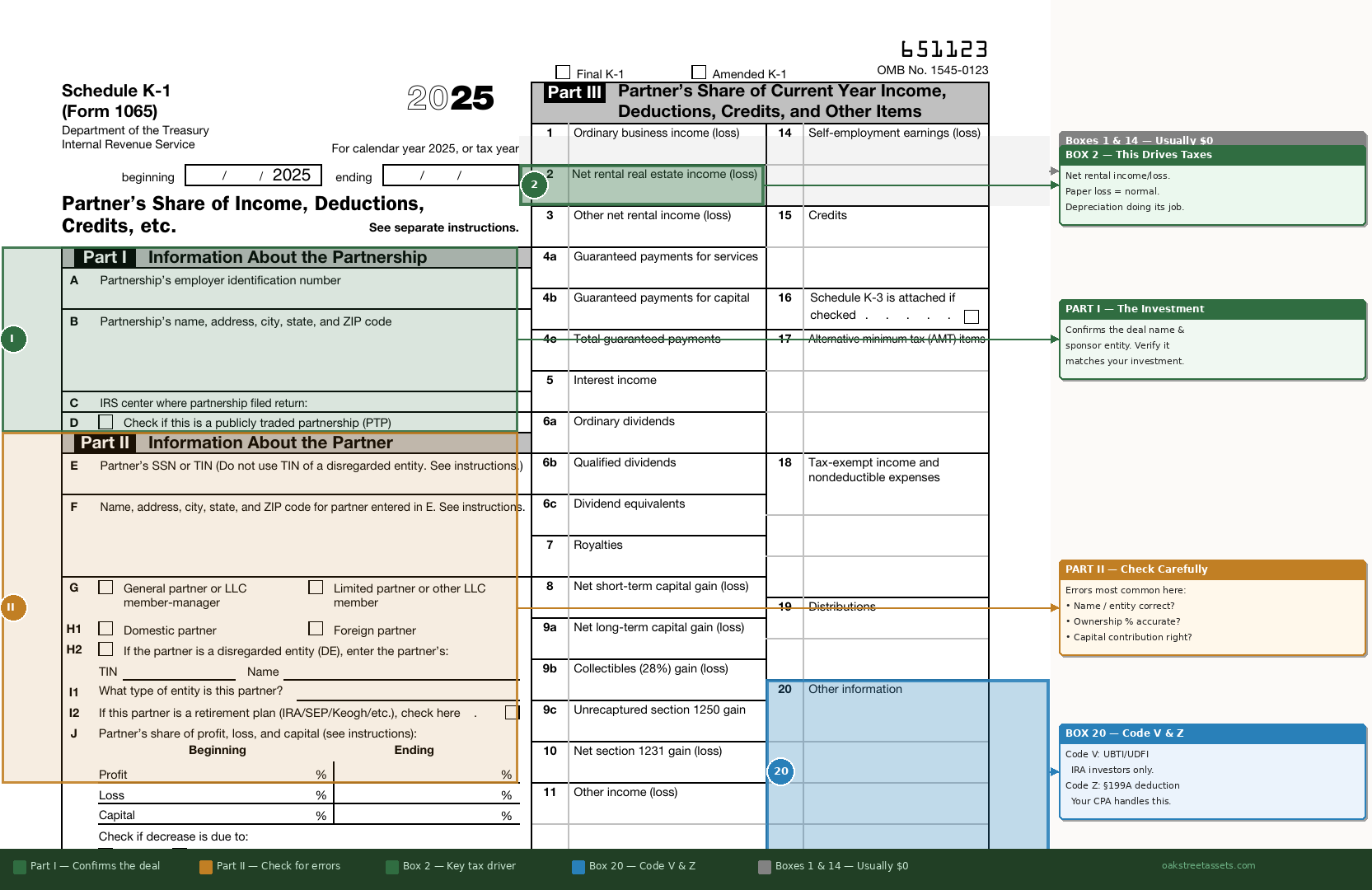
Part I – The Investment
This section identifies the partnership — the name of the deal and the sponsor entity. Confirm this matches your investment. If you’re invested in multiple deals, make sure your CPA has all the right K-1s.
Part II – You
This section identifies your ownership percentage and your capital account — essentially the running record of your equity in the deal. This is also where errors are most likely to occur. Check that your name, ownership percentage, and capital contribution are accurate. If something looks off, contact the sponsor before filing.
Part III – The Numbers
This is where your taxes actually happen. As a passive real estate investor, here’s where to focus:
- Box 1 (Ordinary Business Income/Loss): Often $0 for real estate — most activity flows through Box 2
- Box 2 (Net Rental Income/Loss): This is the key line — your share of the property’s net rental activity after depreciation
- Box 14 (Self-Employment Earnings): Usually minimal or blank for passive investors
- Box 20: This box carries important supplemental information:
- Code V — UBTI/UDFI: relevant if you’re investing through a Self-Directed IRA
- Code Z — Section 199A deduction: a potential additional deduction for qualifying income
Box 2 is the one that drives your taxes. Everything else provides context. Your CPA will handle the rest.
The Most Important Concept: Why You Show a Loss When You Made Money
This is the question I get more than any other, and it trips up new investors every single time — because it seems backwards.
Here’s how it works.
Real estate is one of the only asset classes in the U.S. tax code that allows investors to deduct the theoretical wear and tear on a property — even while that property is appreciating in value. This is called depreciation, and it’s a non-cash expense. No money leaves your account. It’s purely a paper deduction.
In value-add deals — especially those with cost segregation studies — these depreciation deductions can be very large, particularly in Year 1.
Here’s what that looks like in practice:
Cash received: $5,000 in distributions
K-1 shows: ($25,000) lossYou made money AND reduced your taxable income.
That loss on your K-1 doesn’t mean the deal is struggling. It means the tax code is working in your favor. The depreciation deduction offsets not just income from this investment, but potentially other passive income on your return as well.
This is a feature, not a bug. And it’s one of the primary reasons sophisticated investors love real estate.
What Sophisticated Investors Know
There’s a mindset shift that happens once you’ve been through a few cycles of this. Investors who understand real estate taxation stop reacting emotionally to their K-1 and start reading it strategically.
Here’s what experienced investors expect:
- They expect K-1s to arrive late. It’s not unusual. It’s not a problem.
- They expect paper losses. It means depreciation is working.
- They coordinate with their CPAs proactively. They don’t react to K-1s — they plan around them.
- They view K-1s as a feature. Not friction. A tax advantage that’s built into the investment structure.
Getting to this mindset is part of becoming a more sophisticated investor. The K-1 stops being a source of confusion and becomes a signal that the investment is generating the kind of tax efficiency you invested for.
What You Actually Do With Your K-1
This is the practical part. Here’s the entire workflow:
- Step 1: When your K-1 arrives, forward it to your CPA (or upload it to whatever secure portal they use)
- Step 2: Confirm that your name, entity, and capital contribution look correct
- Step 3: That’s it
You don’t need to calculate anything. You don’t need to understand every box. Your CPA will incorporate it into your return.
The only time you need to dig deeper is if something in Part II looks wrong — wrong ownership percentage, wrong contribution amount, wrong entity name. In that case, reach out to the sponsor before filing.
Quick Answers to Common Questions
“Why is my K-1 late?”
Partnership accounting takes time. Depreciation schedules, cost segregation, and property-level tax work must all be finalized before K-1s can be issued. This is normal and expected.
“Is a loss on my K-1 bad?”
Usually the opposite. A paper loss typically means depreciation is doing its job — offsetting income and reducing your tax burden without affecting your cash flow.
“Do I owe taxes because of my K-1?”
It depends on your total tax picture. A passive loss from real estate may offset other passive income, or carry forward to future years. Your CPA will know how it applies to your specific return.
“Does filing an extension increase my audit risk?”
No. Extensions are extremely common and well within normal IRS expectations. In fact, accuracy typically reduces audit risk — which is exactly what waiting for a complete K-1 supports.
The Bottom Line
K-1s are one of the core advantages of real estate investing — a vehicle for turning active income into tax-efficient, passive wealth. Once you understand what you’re looking at, they stop being confusing and start being something you actually look forward to.
Schedule a call here. It’s a quick conversation — and it’s the kind of clarity that changes how you think about your money.